The hidden number in every household-part quote
When a household buyer compares two mold quotes for the same plastic part, the difference is rarely the steel grade on page three. It is the number that sits quietly in the drawing: how many cavities, and how they share the mold base. Cavity count decides how many parts a press produces per hour, and per-hour output — not the tooling invoice — is what your landed cost per piece is really made of. Get the count wrong in either direction and you pay for it every day of the tool's life.
Founded in 2002, KSHOW has tooled household parts for 24 years from Huangyan, Taizhou. A company-recorded 30,000+ molds have gone to 100+ countries, under a quality system certified to ISO 9001 and IATF 16949. That is why our quotes start with the cavity math, not the material list. If you want that calculation run on your own part, write to sale@taizhoumold.com or WhatsApp +86-18957424655 — the cost-per-piece model comes back with the drawing review, with no extra fee for qualified project inquiries.
More cavities are not automatically cheaper
The honest comparison: doubling cavities raises tooling cost 55–75% and slows the cycle from 24 s to 28–32 s, yet still cuts cost per piece by 15–25%. The rule of thumb "double the cavities, halve the price" breaks down fast — each added cavity lengthens the flow, stretches the cooling balance and raises the chance that one bad cavity stops the whole tool. Here is the breakdown:Parameter4-cavity tool8-cavity toolRelative tooling costBaseline+55–75%Typical cycle time24 s28–32 sOutput per 24 h (at mid-range cycle)~14,400 pcs~23,000 pcsCost per pieceBaseline−15–25%Risk if one cavity fails25% of output12.5% of outputBreak-even rule: below roughly half a million pieces a year, a 4-cavity tool often wins; above two million pieces a year, the 8-cavity version is usually cheaper per piece even with its longer cycle. Thresholds assume typical machine-hour rates and tooling premiums; confirm per project.
Family tooling: one mold base, several parts
Small household programs rarely run one part. A window wiper body, a cleaning-brush handle and a rice-cooker spoon share resins, colors and presses — so the tooling can share a mold base too. In a family mold, cavities for two or four different parts sit in one frame with one hot-runner layout. The benefits are concrete:
· One mold base and one hot runner instead of two or three — capex down
· One press instead of two — machine-hour cost down
· Balanced shot: a small part fills alongside a larger one, no micro-shot instability
The trade-off is control: one worn cavity takes the whole tool down, and run sizes must be planned together. Family tooling rewards buyers who can forecast their mix a quarter ahead.
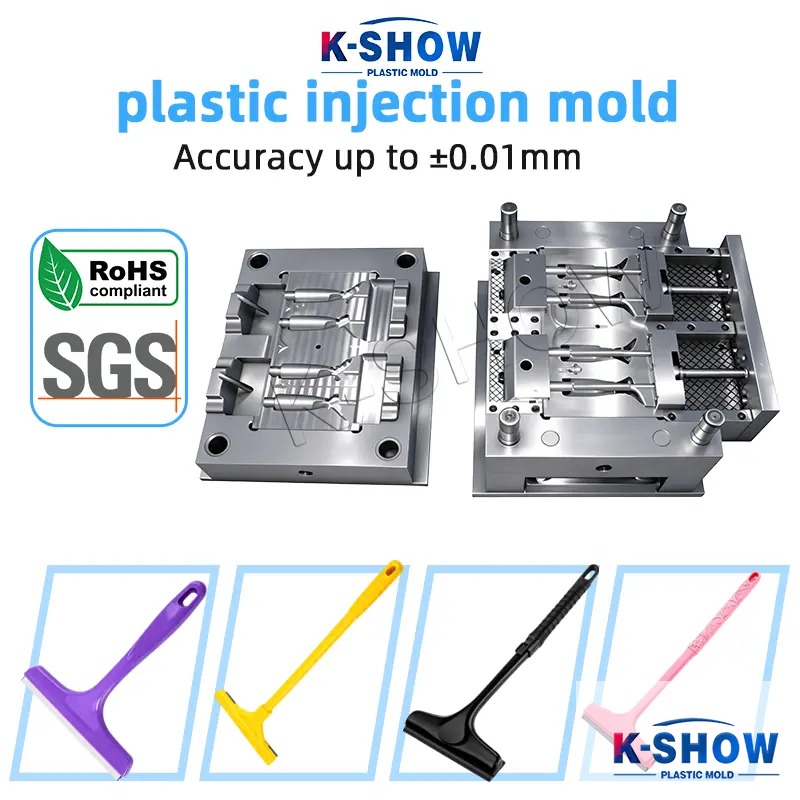
Window wiper body mold · catalog image (taizhoumold.com), not the case tool
KSHOW case: a three-mold kitchen and home set
The figures below are the recorded data of this single project, not a general result.
A European housewares importer needed three small parts on one launch schedule: a window wiper body (PP-T20), a cleaning-brush handle (PP, soft-touch lip) and a rice-cooker spoon (PP, food-grade, textured face). KSHOW built the brush handle and spoon as a two-part family mold on one hot-runner mold base, and the wiper as a standalone 8-cavity tool. Recorded project data:ParameterResultTooling scope1 × family mold + 1 × 8-cavity toolSpoon cavity layout2 × 4, balanced H-patternCycle time (spoon/brush)29 sCycle time (wiper body)26 sT0 (first shot)Day 46 from kickoffCost per piece, family pair vs. separate tools−19%Mold steelP20H, cavity 718HThe commercial outcome: the importer launched all three parts in one season, and the family pair brought the cost per piece 19% below what separate tools would have cost, without touching per-cycle output.
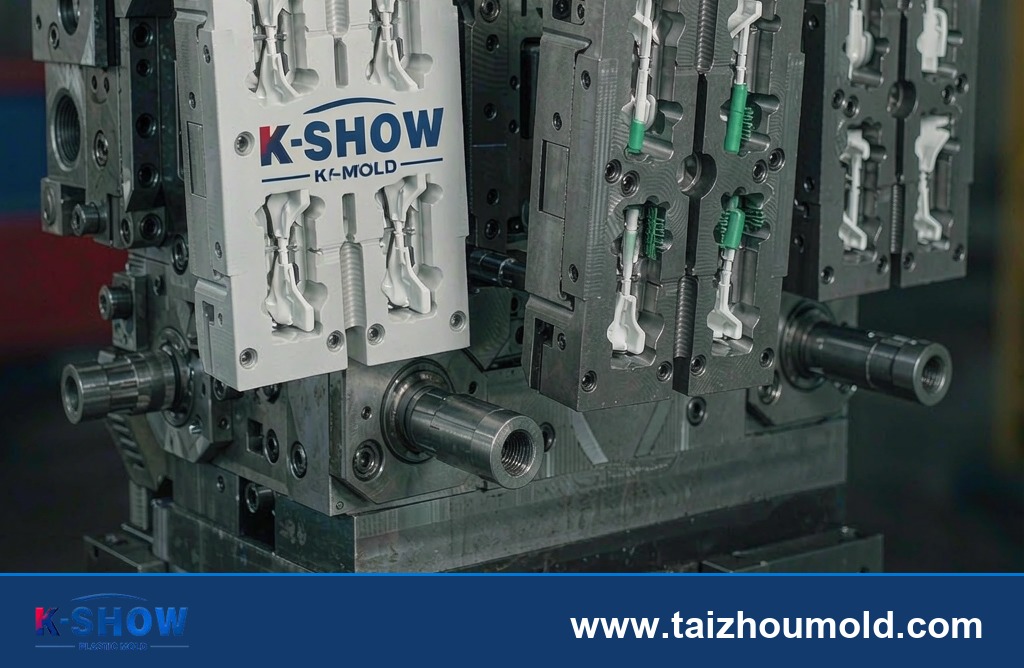
Cleaning-brush handle and holder mold · catalog image (taizhoumold.com), not the case tool
What to Ask Your Mold Supplier Before Signing
· Cost per piece at your real annual volume, not at the tool's maximum output
· Which parts can share a mold base, and what happens when one cavity fails
· The cooling layout for each cavity — small parts lose their margin here first
· A T0 date tied to a penalty clause, not to a polite estimate
Cavity count is a business decision expressed in steel. KSHOW puts the numbers on the quote page where you can check them.
Rice-cooker spoon mold · catalog image (taizhoumold.com), not the case tool. The picture shows a radial layout; the case tool uses a 2×4 balanced H-pattern — two different layouts.
Contact KSHOW
Send your part drawing — the cost-per-piece model comes back with the drawing review, at no extra charge for qualified inquiries. KSHOW shows the cavity math before the tooling price.ChannelDetailsCompanyTAIZHOU K-SHOW PLASTIC MOLD CO., LTDAddressNo.18 Shangxian Road, Beicheng Industrial Zone, Huangyan District, Taizhou City, Zhejiang Province, ChinaPostcode318020ContactRichard, General ManagerPhone / WhatsApp+86-18957424655Emailsale@taizhoumold.comWebsitehttps://www.taizhoumold.comTrack recordEstablished 2002 — 24 years; 30,000+ molds · 100+ countries


-
Phone: +86-18957424655
Mobile: +86-18957424655
Email: sale@taizhoumold.com
Address:No.18 Shangxian Road, Beicheng Industrial Zone, Huangyan District Taizhou City, Zhejiang Province, China
Copyright © 2025 Taizhou Huangyan K-Show Plastic Mold Co., Ltd. All rights reserved.