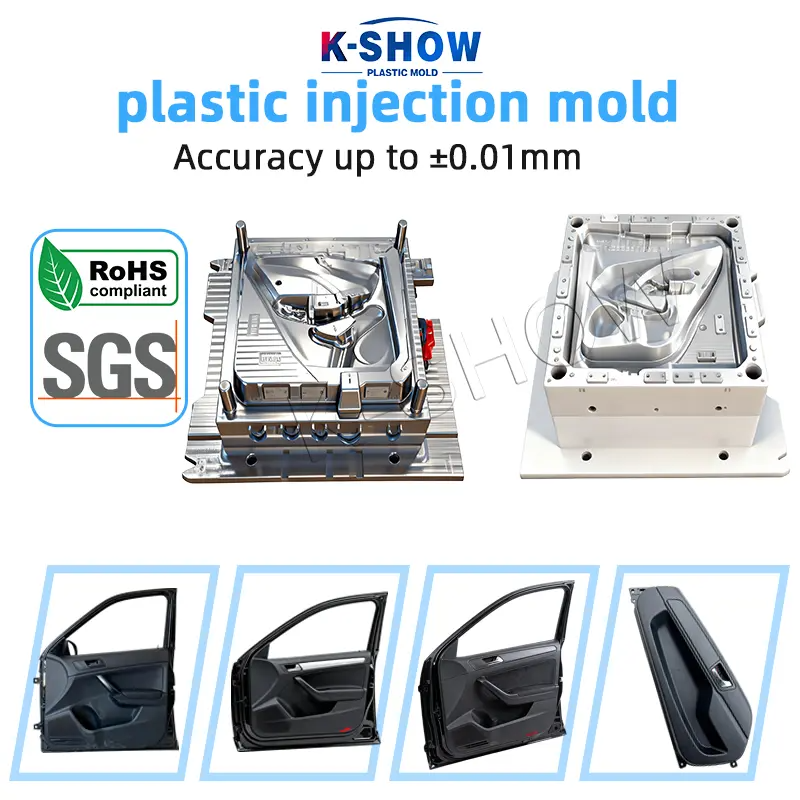
Exterior panels fight stone chips and weather. Interior parts face something harder to engineer for: a decade of daily abuse. A door panel bakes in sunlight on a summer afternoon, then freezes overnight; a glove-box lid is opened by children; an armrest takes body weight every trip. The buyer sees a paint-free plastic surface. The mold maker has to deliver that surface at hundreds of thousands of shots, on parts where the customer's hand can feel a weld line and the eye can catch a gloss mismatch.
This is why interior tooling is judged less on price and more on what it prevents: warpage on long panels, sink over ribs, gate blush on appearance surfaces, and clips that lose holding force after thermal cycling. KSHOW (Taizhou Huangyan K-Show Plastic Mold Co., Ltd.) has built tooling for over 20 years, delivering 30,000+ molds to 100+ countries under ISO 9001 and IATF 16949. Interior parts sit in the middle of that portfolio — the same family of molds we ship weekly to appliance and automotive buyers. To send a trim part for a feasibility review, write to sale@kshowmould.com or WhatsApp +86-18957424655.
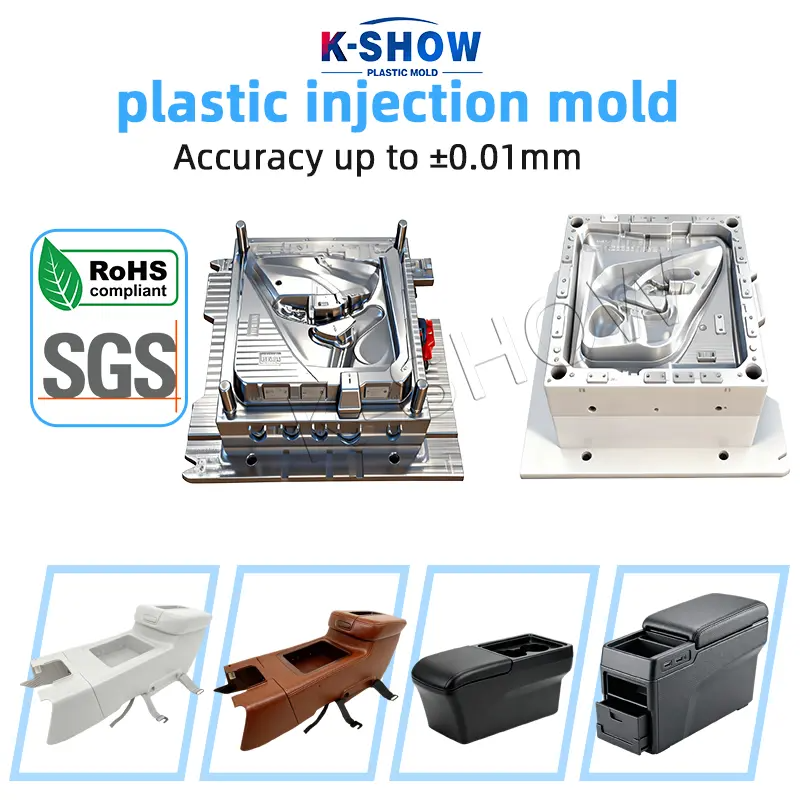
The interior family looks uniform from the outside. In tooling terms, each member brings its own difficulty:
|
Part |
Molding challenge |
Tooling answer |
|
Door panel |
Large area, warp and gloss consistency |
Even cooling layout, sequential valve gates |
|
Glove box |
Snap-fit hooks, tight closing gap |
Precision sliders, ≤0.05 mm fit window |
|
Roof handle |
Load-bearing, textured surface |
Replaceable texture inserts, balanced filling |
|
Armrest box |
Thick sections, sink over latch ribs |
Core-out strategy, local conformal cooling |
The common thread is that most defects are designed out at the mold stage, not corrected by the molder afterwards. A door panel that fills from the wrong end will show a weld line exactly where sunlight strikes it at noon — no process tuning fixes that.
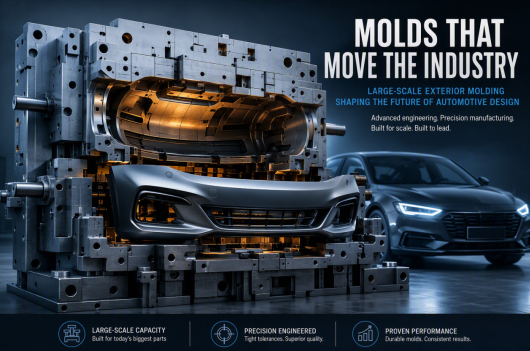
Exterior fender molds are judged on paint-ready geometry. Interior molds are judged on touch. That changes several decisions:
KSHOW treats gap-and-flush as a mold-scope item: the mating surfaces of adjacent tools are dimensioned together in the DFM review, so assembly plants do not inherit a fit problem.
A tier-one automotive supplier needed a glove box, roof handle and door trim panel in PP and PC/ABS for a vehicle platform exported to hot-climate markets. The previous supplier's parts had two recurring complaints: a visible weld line across the glove-box lid, and door panels that warped 1.5 mm at the corners after thermal exposure.
KSHOW re-cut the filling sequence with sequential valve gates, moved the weld line behind the glove-box hinge where it cannot be seen, and added beryllium-copper inserts behind the door-panel corner ribs to equalize corner cooling.

The recorded project data:
|
Parameter |
Result |
|
Materials |
PP (panel), PC/ABS (glove box, handle) |
|
Door panel size |
780 × 450 mm |
|
Corner warp before → after |
1.5 mm → 0.4 mm |
|
Visible weld lines on lid |
eliminated |
|
Clip retention after cycling |
within spec |
|
Cycle time (door panel) |
52 s |
|
Planned tool life |
500,000 shots |
The set passed the customer's hot-climate validation at the first submission, and the glove-box gap tolerance held at ±0.05 mm across the trial batches. The same approach was later extended to an armrest box mold, where the latch rib was cored out and locally conformal-cooled to keep the sink mark below 0.05 mm.
So, can interior trim survive a decade of sun, hand contact and clip loads? Only if the tooling was built with those years in mind. The surfaces customers touch are the hardest place to hide anything — every weld line, every 0.5 mm step and every tired clip tells the story of how the mold was designed.


Phone: +86-18957424655
Mobile: +86-18957424655
Email: sale@taizhoumold.com
Address:No.18 Shangxian Road, Beicheng Industrial Zone, Huangyan District Taizhou City, Zhejiang Province, China
Copyright © 2025 Taizhou Huangyan K-Show Plastic Mold Co., Ltd. All rights reserved.