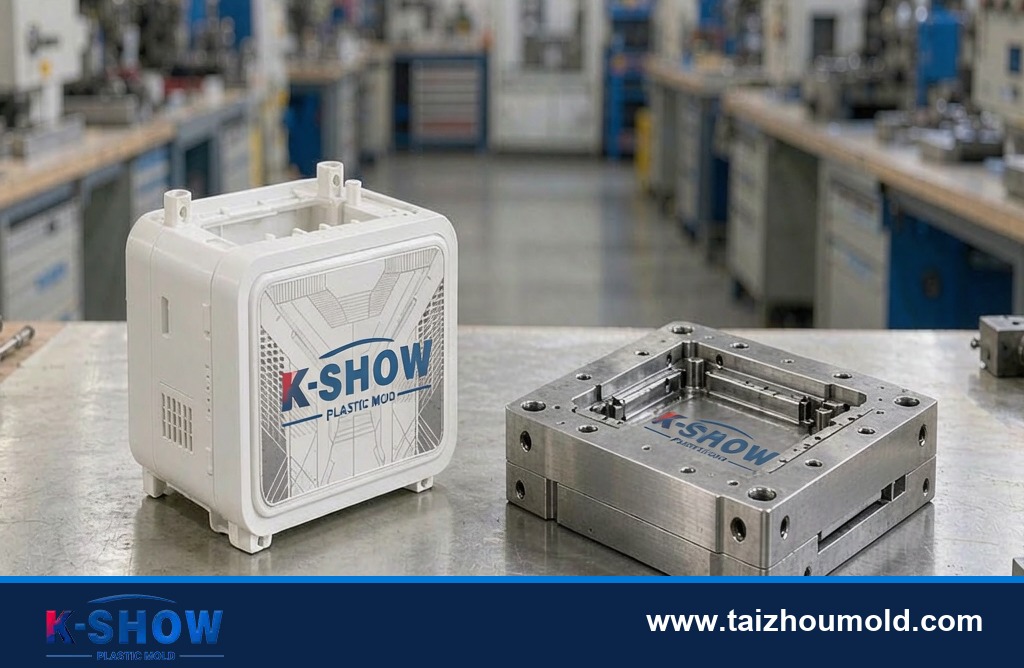
The paint shop: a department that bills nobody
Walk into almost any appliance plant and you will find a department that generates no revenue of its own: the paint line. It takes every housing that injection moulding has already formed to final shape and runs it through masking, spraying, curing and inspection. The part leaves with more process steps on it, yet the cost sheet shows a single line item. It is also the main source of cosmetic rejects, and it sits directly in the path of tightening VOC emission rules in Europe and North America.
In-mold decoration folds that sequence into the moulding cycle: a pre-printed film goes into the cavity, resin is injected behind it, and the graphic becomes part of the wall. No spray booth, no curing oven, no second handling step.
One set of terms needs untangling first, because it decides the durability claim:Abbrev.Full nameWhat happens to the filmWhere the ink sitsFit for appliance panelsIML / FIMIn-Mold Labeling / Film Insert MoldingThe formed film stays on the part for life, fused with the resinBetween film and resin, fully encapsulatedYes — this is the route discussed hereIMD (IMR type)In-Mold Decoration / In-Mold RollerOnly the ink layer transfers; the carrier film is stripped and rewoundExposed directly on the part surfaceUsed for small high-curvature parts; wear resistance depends on the ink systemIMSIn-Mold Screen (another IMD branch)The screen is printed directly in the cavityTop-layer inkMostly small-area, high-curvature decorationWhere this article says the ink is buried under resin and cannot be scraped off, that refers strictly to the IML/FIM route, which is the mainstream choice for appliance housings. On an IMR transfer part, wear resistance depends on the ink system and any added protective coat, and the same conclusion does not carry over.
How the film gets into the wall
The chain has three steps, and the tool has to serve all three.
· Printing: the graphic is printed on the inner face of the film, so the ink touches neither the parting line nor the visible surface.
· Forming and trimming: the flat film is heat-formed to the part's curvature, then trimmed to the insert outline.
· Insert moulding: a robot or an operator loads the film into the cavity, locating pins hold it within a ±0.15 mm window, and resin fills from behind and presses the film flat against the wall.
The result is practical rather than novel: the graphic cannot be scraped off because it sits beneath the part's own resin; curved panels and window cut-outs come out in one shot; colour reproduces because the film carries the appearance, not the spray gun in an operator's hand.
Six measurable differences between post-mould painting and IMD/IML:ItemPost-mould paintingIMD / IML (IML route)Secondary operationsSpray + cure + inspectNone; decoration happens inside the cycleCosmetic scrap rate (industry-typical)Typically 3–7%Typically 1–2%Surface durabilityLimited; edges chipHigh; ink is encapsulated by film and resinCycle timeShorter moulding, plus paint labourFilm loading adds 2–4 sPlant VOCSolvent handling and abatement neededNo spray solvent in the moulding shopBest fitLow volume, deep draw, many variantsHigh volume, flat to gently curved panelsNote: the scrap rates above are cross-project experience ranges, given to establish order of magnitude and not as a performance commitment on any specific job. The figures in the next section are a single project's measured record; the two are not directly comparable.
Case: a heater housing family that left the paint line
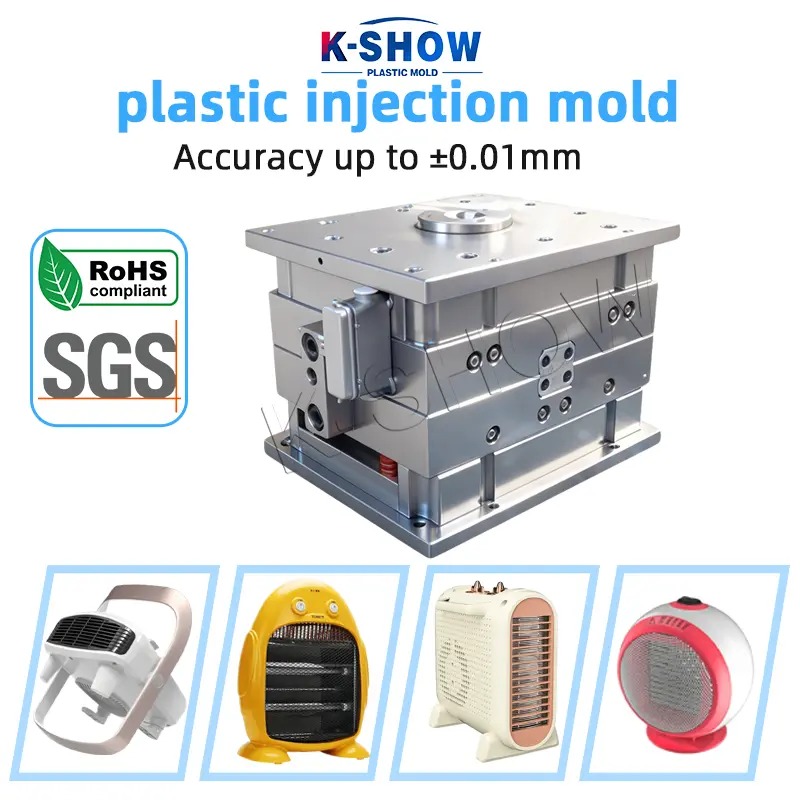
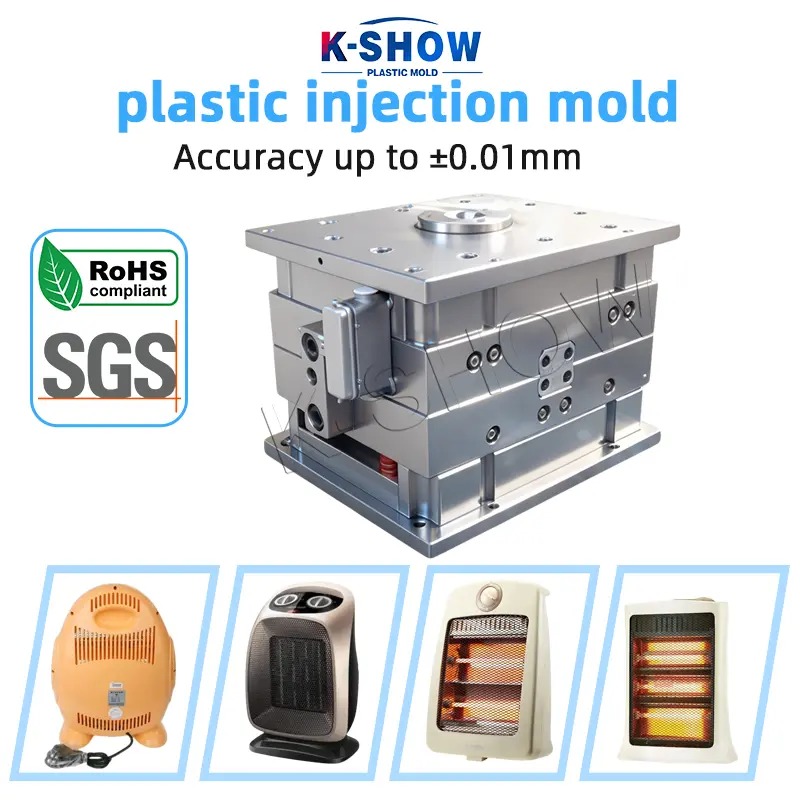
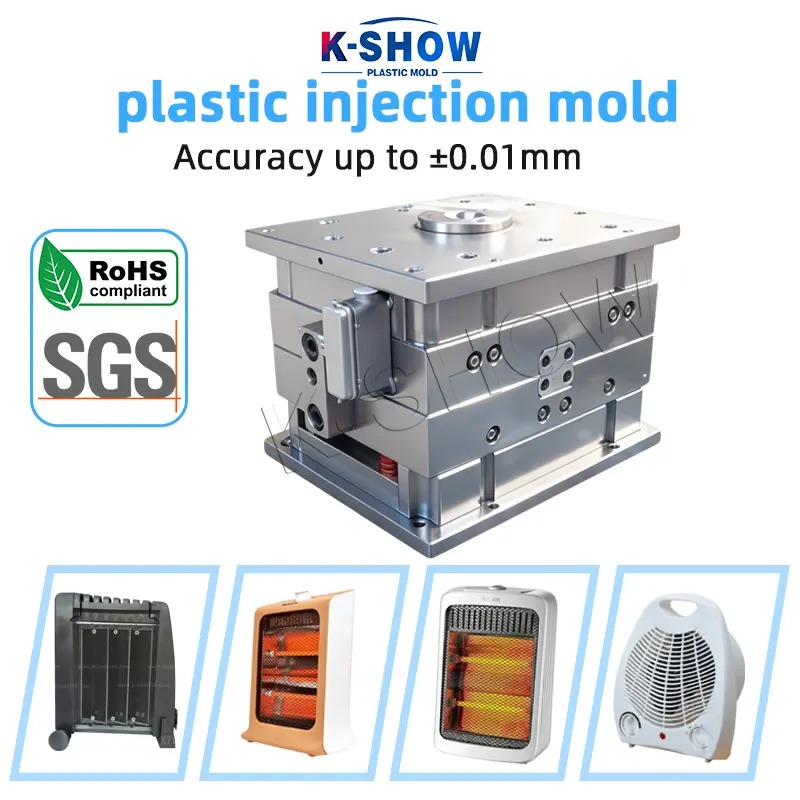
A Middle East appliance brand refreshed its electric heater family — two housing sizes plus a front panel — and wanted the decorated surfaces out of the paint shop entirely, for cost reasons and for its own sustainability targets. KSHOW rebuilt three tools around one common IML panel specification: first qualifying the film supplier's printed material for ink adhesion and formability, then holding the insert within ±0.15 mm using tapered locating pins.
The first full month after ramp-up recorded the following:MetricBefore (painting)After (IML)ChangeDecoration cost per setUSD 0.42USD 0.28−33%Cosmetic scrap rate6.2%1.4%−4.8 pointsMoulding cycle46 s49 s+3 s (+6.5%)Secondary process steps50EliminatedFirst-pass yield91.8%98.3%+6.5 pointsThree seconds longer per cycle — why does the arithmetic still win?
The answer is not in the three seconds themselves but in the order of magnitude they carry. At a fully loaded machine rate of USD 25–40 per hour, 3 s is roughly USD 0.02–0.03 per shot. Decoration cost falls by USD 0.14 per set, so even on the most conservative one-part-per-shot basis, the net gain stays above USD 0.11 per set. That is the cycle-time calculation alone.
The real gap opens in three other places. First, five secondary operations disappear outright, taking with them handling, masking, curing energy and work-in-progress. Second, scrap falling from 6.2% to 1.4% saves not only material but the machine hours and labour already sunk into each rejected part. Third, repaint capacity is released, so floor space and headcount reserved for rework can take new orders. None of this appears on a piece price, and all of it occupies plant floor.
The machine rate above is an industry-typical range. A specific project should substitute the customer's own depreciation, energy and labour rates. KSHOW builds a customised model at the DFM review stage using the customer's capacity parameters.
Within two quarters the brand had shut down the housing paint station.
Where it pays, and where it does not
IMD/IML pays when three conditions hold at once: annual volume is high enough to amortise the film tooling, the decorated surface is flat or gently curved, and the graphic is multi-colour or a gradient. Conversely, a deep-drawn part with sharp corners is usually the wrong candidate.
An experienced mould engineer talks customers out of a project about as often as into one. The boundary runs roughly like this:
· Above 100,000 parts a year: film tooling and debug costs amortise effectively. Below that, painting usually stays cheaper.
· Front panels, control panels, cover faces: high decorative value with gentle curvature, the most typical fit.
· Deep draws with sharp corners: film thinning and wrinkling become real risks, and the toolmaker should run a formability study first.
· Multi-colour marks and gradients: IMD prints them in one pass, where painting needs multiple masks and cure cycles.
KSHOW works the arithmetic before quoting. If the geometry fights the film, the recommendation is to stay with painting — which has saved customers the cost of a tool they should not have built.
Before you order, put these in writing to your toolmaker
The list is ready to use as is; all eight items share one trait — they are expensive to fix after the fact.
· Film supplier and grade, locked early. Printability and formability are material decisions, not procurement-week decisions.
· Resin grade compatibility with the film. PP, ABS, PC/ABS and PMMA differ noticeably in adhesion and shrinkage; confirm before cutting steel.
· Keep the decorated area flat or gently curved; for anything deeper, require a film-thinning analysis from the toolmaker first.
· Insert loading method, robot or manual, matched to annual volume. A robot on insufficient volume never pays back.
· Gate position relative to the film. An aggressive gate jet displaces the film or scours the ink; settle it at design stage, not at trial.
· Parting-line clearance at the film edge, plus the locating method: vacuum, electrostatic or mechanical pins.
· Acceptance criteria for adhesion and mar resistance, signed before T0. Common references are cross-cut methods (ISO 2409, ASTM D3359) and pencil hardness (ASTM D3363); which ones apply follows the end customer's quality agreement, and should not be settled after trials.
· Cosmetic acceptance: A-surface extent, colour tolerance, permissible defect size, and the sampling plan, all written into the acceptance file before T0 as well.
One film in the cavity replaces the whole chain of spray, cure and inspection. That is the whole mechanism, and it is why decorated tools keep taking work that used to belong to the paint shop. KSHOW builds both kinds: decorated tools, and plain tools the customer paints in-house. So the advice depends on the part, not on which tool we would rather sell.
FAQ
What is the difference between IMD and IML?
IML (In-Mold Labeling, also called FIM) leaves the formed film permanently on the part, with the ink between film and resin. IMR-type IMD transfers only the ink layer and strips the carrier. Durability conclusions therefore differ: the first has film as its surface, the second has ink. Appliance front panels are mostly IML.
At what annual volume does IMD undercut painting?
Roughly 100,000 parts a year as a reference line. Below that, film tooling and debug costs are hard to amortise and painting is usually more economical. The line is not a hard threshold; the actual crossover depends on part size, film unit price, film scrap rate, and local compliance costs for solvent use and emissions, so it needs project-level calculation.
Can deep-drawn or sharp-cornered parts be done in IMD?
Technically yes, but risk rises noticeably: the film thins locally in a deep draw and tends to wrinkle or tear at sharp corners. The way to decide is to have the toolmaker run a thinning simulation before steel is cut, report the minimum wall at the thinnest point and the safety margin, and choose on that basis. If the margin is thin, painting or partial decoration is the safer route.
Do PP, ABS and PC/ABS all work?
These are the common appliance housing materials and all have matching film options, but each pairing has to be confirmed item by item: resin shrinkage and flow must match the film's adhesion system. For a specific grade, send the material datasheet to the DFM review and let engineering check it.
Can in-mold decoration replace painting entirely?
No. It replaces one class of need: large-area decoration on flat to gently curved surfaces. Irregular parts, local gradients running to an edge, dark colours needing very high opacity, and very small batches all still favour painting. Treating IMD as the only alternative to paint is how the wrong process gets chosen.
Contact KSHOW
Send a part drawing and we will run a first-part DFM review — the assessment itself is not charged, and the scope of any follow-on service is confirmed between us. Before quoting we give you the IMD-versus-painting call, including the cases where we advise against IMD.ChannelDetailCompanyTAIZHOU K-SHOW PLASTIC MOLD CO., LTDChinese name台州市黄岩凯成模塑有限公司BrandKSHOW (use this spelling throughout)AddressNo. 18 Shangxian Road, Beicheng Industrial Zone, Huangyan District, Taizhou, Zhejiang 318020, ChinaContactRichard, General ManagerPhone / WhatsApp+86-18957424655Emailsale@taizhoumold.comWebsitehttps://www.taizhoumold.comEstablished2002 — 24 years in mould makingTrack record30,000+ moulds delivered, 100+ countries servedCertificationsNational High-Tech Enterprise · IATF 16949 · ISO 9001


Phone: +86-18957424655
Mobile: +86-18957424655
Email: sale@taizhoumold.com
Address:No.18 Shangxian Road, Beicheng Industrial Zone, Huangyan District Taizhou City, Zhejiang Province, China
Copyright © 2025 Taizhou Huangyan K-Show Plastic Mold Co., Ltd. All rights reserved.