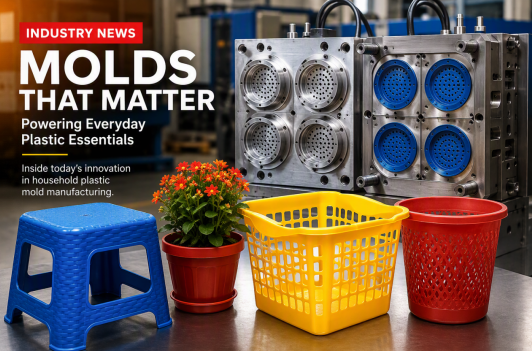
Every home hides dozens of injection-molded daily-use items: a dustpan, a storage box, a soap dish, a dining chair. Unlike automotive or medical parts, these products sell at tight retail prices, which puts enormous pressure on the mold cost per part. The global household plastic goods market is estimated at over USD 60 billion per year, and nearly every piece traces back to a mold shop like KSHOW in Huangyan.
KSHOW (Taizhou Huangyan K-Show Plastic Mold Co., Ltd.) has built its household commodity mould range over 20 years, with 30,000+ molds delivered to 100+ countries. Its daily-use portfolio spans cleaning tools, storage products, kitchenware, bathroom ware and chairs. The engineering question behind all of them is the same: how do you make a mold that is affordable to buy, cheap per shot, and still durable enough for millions of cycles? Contact KSHOW at sale@kshowmould.com or WhatsApp: +86-18957424655.
Daily-use molds live or die on cost per part, a formula driven by three variables: cycle time, cavity count, and mold life.
|
Variable |
Impact |
Typical KSHOW approach |
|
Cycle time |
Shorter cycle = more parts per day |
Optimized cooling layout, 25–60 s cycles |
|
Cavity count |
More cavities = more parts per shot |
2–8 cavities on standard frame sizes |
|
Mold life |
Longer life = lower amortized cost |
P20H / 718H steel, 500k–1M+ cycles |
The trick is balance. Adding cavities lowers per-part cost but raises mold price and risk; chasing ultra-short cycles can shorten mold life. KSHOW's engineers treat the whole-life cost — mold price plus shots per day plus maintenance — as the real number the customer should watch.
A European cleaning-brand customer needed a plastic dustpan with a molded-in rubber lip, a part consumers buy for a few euros. KSHOW designed a two-cavity stack mold in PP, combining a hot runner and a cold runner to keep the mold compact and affordable. The result: a 25-second cycle, roughly 6,900 dustpans per day on a single machine, with ±0.3 mm critical tolerances that matter for the snap-fit lip.
The customer reported over one million cycles before the first major service, and has since ordered three more molds for other cleaning products. For KSHOW, this is the pattern of daily-use tooling: unglamorous parts, engineered with disciplined simplicity.
Storage products reverse the equation — they are bigger, so warpage control replaces cycle speed as the priority. A clothes storage box mold built by KSHOW measures about 600 × 400 mm per part with 2.0–2.5 mm walls in copolymer PP. The challenge is flatness: a bowed lid or base is a rejected product at the end of the line.
KSHOW used conformal cooling in the large flat cores and balanced the gate layout to equalize shrinkage. The mold achieves a 55-second cycle with flatness within 0.5 mm across the full face, letting the customer run it unattended for long shifts. Material savings from the thin-wall design reached an estimated 15% versus the previous thicker part.
A dining chair must carry over 100 kg of load while staying light enough to stack and ship cheaply. KSHOW's plastic dining table and chairs mould work demonstrates how rib design and wall-thickness distribution give stiffness without adding material. Ribs under the seat and cross-bracing in the legs turn a flexible plastic into a structurally rigid product, while vent placement prevents sink marks on visible surfaces.
Chairs also illustrate the mold-life economics of daily-use tooling: a chair mold typically runs 700,000–1,000,000 cycles, so the steel choice — KSHOW uses 718H for these large molds — matters more than the mold price itself.
● Ask for the cost per part, not just the mold price.
● Confirm cycle time and cavity count on your machine size.
● Check cooling layout — it decides cycle time and warpage.
● Verify steel grade for the expected production volume.
● Request trial reports showing part weight and dimensions.
With household commodity molds from dustpans to chairs, KSHOW keeps the engineering focused on the number that matters most: your cost per good part.
|
Channel |
Details |
|
Company |
Taizhou Huangyan K-Show Plastic Mold Co., Ltd. |
|
Address |
No.18 Shangxian Road, Beicheng Industrial Zone, Huangyan, Taizhou, Zhejiang, China |
|
Phone / WhatsApp |
+86-18957424655 |
|
|
sale@kshowmould.com |
|
Website |
www.taizhoumold.com |
|
Track record |
20+ years |
Phone: +86-18957424655
Mobile: +86-18957424655
Email: sale@taizhoumold.com
Address:No.18 Shangxian Road, Beicheng Industrial Zone, Huangyan District Taizhou City, Zhejiang Province, China
Copyright © 2025 Taizhou Huangyan K-Show Plastic Mold Co., Ltd. All rights reserved.