Follow Us:

News

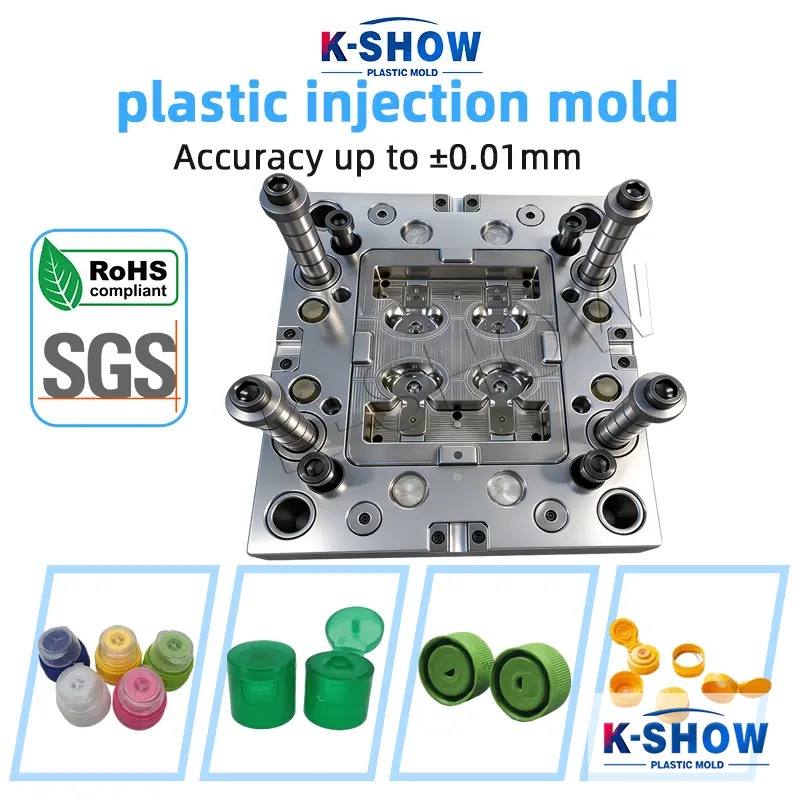
Why Do Caps Start Leaking at the Third Million? A Guide to Closure Molds

2026-11-04 0 Leave me a message

A cap is a precision part wearing a cheap costume

Nobody audits a bottle cap the way they audit a gear — and yet the cap does precision work every day: it holds a thread, seals a liner face, survives a tamper band and is torqued on and off for months. When a closure line starts leaking at a few caps per ten thousand, filling lines foam, claims arrive, and nobody can point to the cause, because the cause was decided in the mold, long before the first leak.

A mold does not wear its way to a leak at some distant shot count. The old tool in the case below leaked at roughly one cap in two thousand — multiply that by three million caps and you get about fifteen hundred leaking caps, and every one of them becomes a claim. The third million is not when a cap starts to fail; it is when the arithmetic stops being ignorable.

KSHOW, founded in 2002, has built tooling for 24 years, with 30,000+ molds delivered to 100+ countries under ISO 9001 and IATF 16949, and closures are one of the most demanding categories in that count — small parts, high cavities, tight tolerances that cannot hide behind wall thickness. If your current closure tooling has become the bottleneck nobody can explain, send the cap drawing and neck finish to sale@taizhoumold.com or WhatsApp +86-18957424655, and we will review it before you commit to new steel.

What are the three failure modes buyers actually test for?

Caps leak, break or jam for three mold-side reasons: a leak at the seal face, a hinge break, and cross-threading or high torque. Two of the three trace to runner imbalance, not wear — and because each traces back to a specific mold decision, each can be designed out.Failure modeWhat the customer seesMold-side countermeasureLeak at seal faceFoaming fillers, wet cartonsSeal-face diameter and ovality controlled at the cavity; venting around the seal beadHinge breakCaps snapping after weeks on the shelfHinge thickness within ±0.03 mm; flow balanced so both hinge wings fill equallyCross-thread / high torqueCapping machine jams, torque driftsThread formed in the core, not the cavity; unscrewing before ejection, no forced strippingHow imbalance becomes a leak: in a high-cavity tool, if one drop runs, say, 0.2 seconds late, its caps cool differently, and its seal diameter walks out of tolerance while the neighbouring cavities stay perfect. That is why closure molds are won or lost on the runner layout before anyone touches a cavity plate.


How many cavities should a cap mold have?

Short answer: below about 100 million caps a year, 24–32 cavities usually beat 48 on real cost per good cap. The full arithmetic:

· Below ~100 million caps a year, 24–32 cavities usually beats 48 on real cost per good cap

· Threaded closures need unscrewing (or very careful stripping for thin PP); forcing the thread off scrubs ovality into the part

· Thin-wall water caps can cycle at 5–6 seconds; heavier juice or tea closures live at 9–12 seconds — size the press for the resin, not the brochure

· Valve-gated hot runners with balanced drop lengths keep the seal face within tolerance across the whole plate

KSHOW sizes closure tools against the customer's press park first, because a 48-cavity tool on the wrong press produces expensive scrap at high speed.

KSHOW case: a 32-cavity tea-drink closure rebuilt around balance

A beverage-filling customer ran a 32-cavity threaded closure tool in HDPE for a 38 mm neck finish, and its older tool leaked on roughly one cap in two thousand after sterilisation — invisible at filling, obvious in the warehouse. KSHOW rebuilt the tool around a balanced hot runner with equal drop lengths, moved the thread into unscrewing cores, and locked the seal-face ovality at the cavity. Results from the first production month:ParameterResultCavities32, unscrewing, equal drop lengthsResin / neck finishHDPE / 38 mmCycle time11.2 s → 9.6 sLeak test (0.4 MPa, 60 s)0 failures in 10,000 capsSeal-face ovality after demolding≤ 0.05 mmWeight variation± 0.05 gCPK, seal-face diameter1.45On the leak test: 0 failures in 10,000 caps is a "not observed" result — the 95% upper bound is still around 0.03%, so read it as a step change in level, not as proof of zero.

The commercial outcome: sterilisation-related claims fell to effectively zero, and the capping line torque band tightened enough that the filler team stopped re-tuning between shifts. The cap still looks cheap. The mold underneath it is not.


What to specify before ordering closure tooling

· Neck finish standard and torque specification, in writing

· Leak-test method and pressure your filling line actually uses

· Annual volume and shifts, so cavity count is sized to demand

· Resin and any PCR share — PCR changes shrinkage and hinge behavior

· The fill line's capping head type, so thread geometry matches reality

Closures reward the boring discipline: balance, threads that unscrew, ovality held at the cavity. KSHOW builds that discipline into the tool before the first cap is molded — which is how a rebuilt tool goes from one leak in 2,000 to zero observed leaks in 10,000 caps.

Frequently asked questions

Q: Why do bottle caps leak?

A: The three mold-side causes are a leak at the seal face, a broken hinge, and cross-threading or high torque. Two of the three trace to runner imbalance: if one hot-runner drop runs 0.2 seconds late, its caps cool differently and the seal diameter walks out of tolerance while neighboring cavities stay perfect.

Q: How many cavities should a cap mold have?

A: Below about 100 million caps a year, a 24–32 cavity tool usually beats a 48-cavity tool on real cost per good cap. Cavity count should be sized to annual volume and press availability — a 48-cavity tool on the wrong press produces expensive scrap at high speed.

Q: Should threaded caps be unscrewed or stripped from the mold?

A: Threaded closures need unscrewing: the thread is formed in the core and unscrewed before ejection, with no forced stripping. Stripping is only considered carefully for thin-wall PP — forcing the thread off scrubs ovality into the part.

Q: What leak-test results did the rebuilt 32-cavity mold achieve?

A: In the first production month: 0 failures in 10,000 caps at 0.4 MPa / 60 s, seal-face ovality ≤ 0.05 mm after demolding, weight variation ± 0.05 g, CPK 1.45 on seal-face diameter, and cycle time down from 11.2 s to 9.6 s.

Contact KSHOW

Send your cap drawing and neck finish — if the project fits our process window, the DFM review is free: KSHOW answers with a balancing plan, not a catalogue.ChannelDetailsCompanyTAIZHOU K-SHOW PLASTIC MOLD CO., LTDAddressNo.18 Shangxian Road, Beicheng Industrial Zone, Huangyan District, Taizhou City, Zhejiang Province, ChinaPostcode318020ContactRichard (General Manager)Phone / WhatsApp+86-18957424655Emailsale@taizhoumold.comWebsitehttps://www.taizhoumold.comTrack recordFounded 2002 — 24 years · 30,000+ molds · 100+ countries

Related News
Leave me a message
X
We use cookies to offer you a better browsing experience, analyze site traffic and personalize content. By using this site, you agree to our use of cookies. Privacy Policy
RejectAccept